Consolidate the stack
Replace a PBX, a call-center platform, an SBC, and a recording server with one system — fewer vendors, fewer integrations, lower total cost.
One platform for every conversation, on hardware you own.
A full PBX, integrated call center, carrier trunking, compliant call recording, and live operational visibility — unified in one multi-tenant, standards-based appliance you own and control.
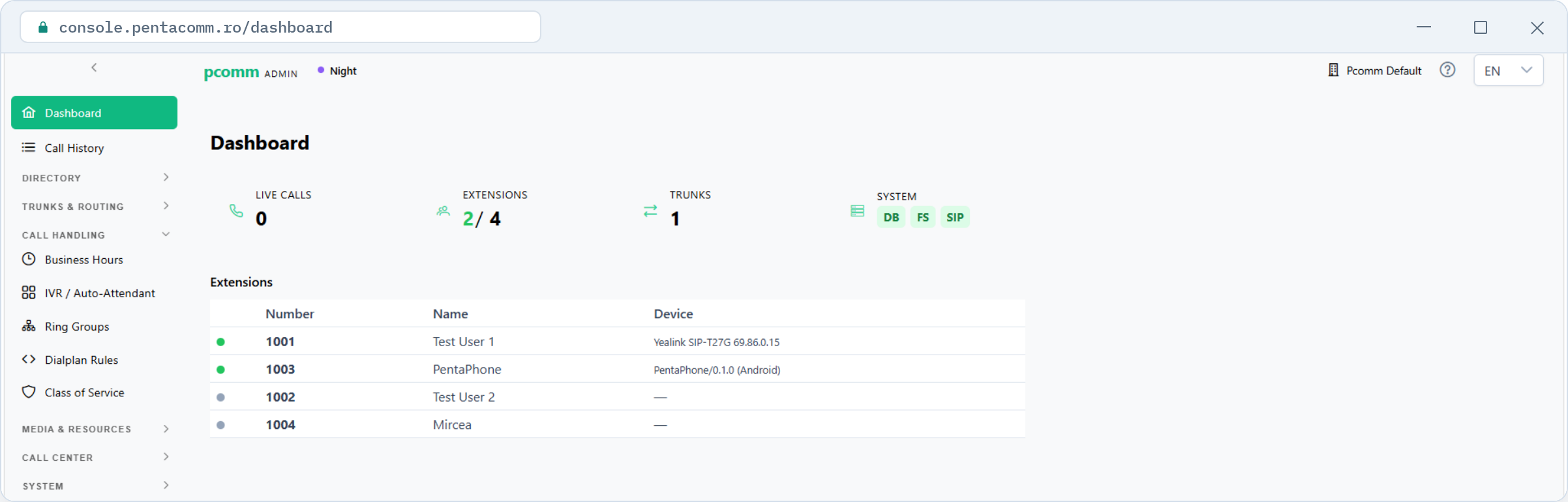
Pentacomm consolidates the systems an organization normally buys separately — a phone system, a contact-center suite, a session border controller, and a call recorder — into a single, self-contained appliance managed from one web console. It runs on your own hardware or private cloud, so calls, recordings, and customer data never leave your control.
Because Pentacomm is multi-tenant at its core, one appliance can serve many departments, sites, or customers in complete isolation. And because it speaks open telecom standards end to end, it interoperates with any SIP carrier and any standards-based phone or browser — with no proprietary lock-in at the protocol layer.
Replace a PBX, a call-center platform, an SBC, and a recording server with one system — fewer vendors, fewer integrations, lower total cost.
Deployed on-premises or in your private cloud. Media and recordings stay inside your perimeter, encrypted and under your control.
GDPR consent prompts, caller opt-out, pause / mask recording, and a full audit trail are built in — not bolted on.
Standards-based SIP and WebRTC mean you keep your carriers, your numbers, and your phones. Switch providers without switching platforms.
Service providers and multi-site enterprises host many isolated organizations on a single, database-enforced multi-tenant platform.
A single install and a guided first-boot wizard take a clean server to a live system in minutes.
Each area below is production-ready today and managed from the same console, with role-based access for administrators, supervisors, and agents.
Extensions, ring groups, inbound and outbound routing with trunk failover, weekly business-hours modes and holidays, voicemail with message-waiting indication, and class-of-service dialing controls.
Multi-level, menu-driven auto-attendants — DTMF menus, time-of-day routing, prompt playback and directed call handling to extensions, queues, voicemail or sub-menus. Edits are live on the next call, no reload.
Queues and agents, an in-browser WebRTC softphone (no plugins), a live wallboard, supervisor KPI reports and QA scoring, scheduled callbacks, and self-service agent and supervisor portals.
Multi-party audio conferencing with PIN-protected rooms, moderator controls (mute, kick, lock, record), scheduling with dial-out to invitees, and a live web console — secured by the same SRTP media edge.
SIP trunks in register, auth, or peer mode with ordered failover and per-trunk caller-ID rules. A hardened media edge terminates SRTP / DTLS so every leg — carrier, desk phone, or browser — is encrypted.
Inbound and outbound fax over T.38 (with G.711 / T.30 fallback) — a web fax inbox, PDF send, and secure fax-to-email delivery, encrypted at rest per tenant. Runs on the same appliance, with no fax hardware and no separate fax server. A licensable module.
Per-tenant call recording encrypted with dedicated keys. GDPR consent announcements, DTMF opt-out, periodic beep, and supervisor pause / mask keep you on the right side of regulation.
Searchable call-detail records with CSV, XLSX, and PDF export; a real-time dashboard of live calls and registrations; a GDPR-grade audit log; and live diagnostics for operations teams.
A perimeter firewall with automated intrusion-prevention jails that detect and block SIP scanners, credential brute-force, and web-login abuse — with allow / block lists and per-jail tuning from the console.
Strict per-tenant isolation enforced in the database, role-based access control, TLS throughout, and an offline license bound to the hardware to prevent cloning.
Installed from a single package with a guided setup wizard. There is no sprawl of servers to integrate — the PBX, call center, trunking, recording, and reporting are one coherent system.
A standards-conformant SIP edge and secure WebRTC softphones mean interoperability with any carrier and any compliant device. Your investment is protected against any single vendor's roadmap.
Recording consent, opt-out, pause / mask, encryption, and audit logging are core features — giving legal and compliance teams the controls they need without custom work.
Tenant isolation is enforced at the database layer, not left to application convention. One customer can never see another's data.
An automated SIP call-flow test suite exercises real scenarios on every release, so upgrades are safe and behaviour is predictable in production.
On-premises or private-cloud deployment keeps numbers, recordings, and customer data inside your control.
Fewer vendors. Lower cost. Full control of your data — and the compliance evidence to prove it.
Pentacomm is a layered, single-appliance stack. A SIP proxy handles all signalling at the network edge; a media relay is the sole path for audio, so the media/application server never faces the public network. A REST backend drives configuration and real-time control, and every tenant's data is isolated in the database.
Pentacomm runs the entire stack on one appliance, so capacity scales with the cores, memory and storage you give it. The figures below are indicative, assuming standard G.711 / Opus pass-through media (no transcoding) with SRTP relayed through the kernel media edge. Real-world capacity depends on your codec mix, recording ratio and average call duration — we certify a target profile with a proof-of-concept load test.
Purpose-built, ready-to-rack appliances — each with four Gigabit network interfaces for clean separation of carrier, LAN, management and out-of-band traffic.
Branch / SMB — 4-core CPU, 8 GB RAM, 240 GB SSD, 4× 1 GbE. Up to ~100 endpoints and ~50 concurrent calls.
Mid-market — 6-core CPU, 16 GB RAM, 2× 480 GB SSD (RAID 1), 4× 1 GbE. Up to ~500 endpoints and ~120 concurrent calls.
Enterprise — 8-core CPU, 32 GB RAM, 2× 960 GB SSD (RAID 1), 4× 1 GbE. Up to ~2,000 endpoints and ~250 concurrent calls.
The same platform as a VM on your VMware, Proxmox, KVM or private-cloud hypervisor, in four sizing tiers. The largest, high-density tier is virtual-only.
The platform evolves on a published roadmap. The following capabilities are in active development, building on the same standards-based foundation.
A drag-and-drop call-flow builder — design menus, prompts, business-hours branches, queue and voicemail targets on a visual canvas, with no scripting. Publishes straight to the live dialplan, on top of the standard IVR that ships today.
Conversational, natural-language self-service — speech-to-text, intent understanding and text-to-speech let callers be routed and served by voice, with graceful hand-off to a live agent.
Hospitality / PMS integration — wake-up calls, room status and check-in/out, minibar posting and per-room call billing, linked to the property management system. A licensable module for hotels.
See Pentacomm running on a live appliance and PentaPhone registered against it — or against your existing SIP platform. Talk to us about a proof-of-concept, licensing, and deployment.
Talk to us