One device, one number strategy
The office extension travels with the employee. Calls to the company number ring the mobile over data; outbound business calls present the company identity — lower mobile charges, consistent customer-facing numbers.
Company VoIP and mobile GSM, unified in one secure Android dialer.
PentaPhone turns every Android phone into a fully-fledged extension of the company phone system — the desk-phone feature set, standards-based push reachability, and encryption on every call, on the phones your employees already carry.
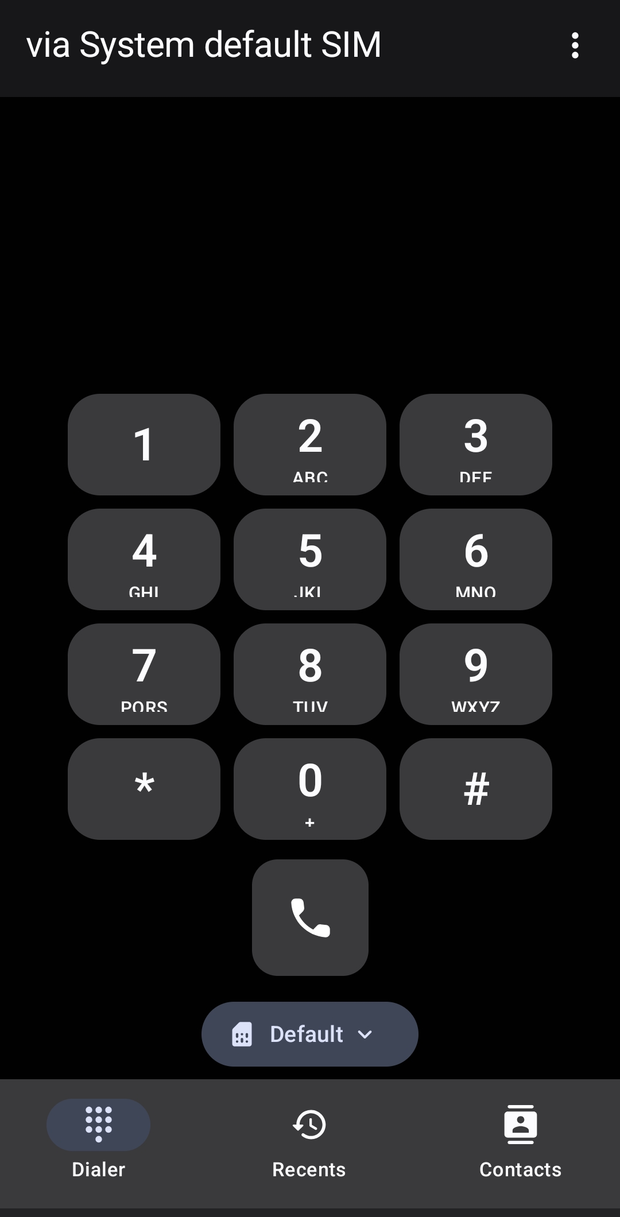
PentaPhone becomes the phone's default dialer, so company VoIP calls (SIP) and regular mobile (GSM) calls live in the same interface, the same call log, and the same contacts. Employees keep one device and one habit; the company gains desk-phone features, central control, and full call security on every handset.
PentaPhone is the mobile endpoint of the Pentacomm communications platform, built and supported by Pentagon Business COM. Because it speaks open telecom standards end to end, it also interoperates with any standards-compliant SIP infrastructure — no proprietary lock-in at the protocol layer.
Real captures from the app — choosing the line, the active call, hold and swap, live quality and QR provisioning.
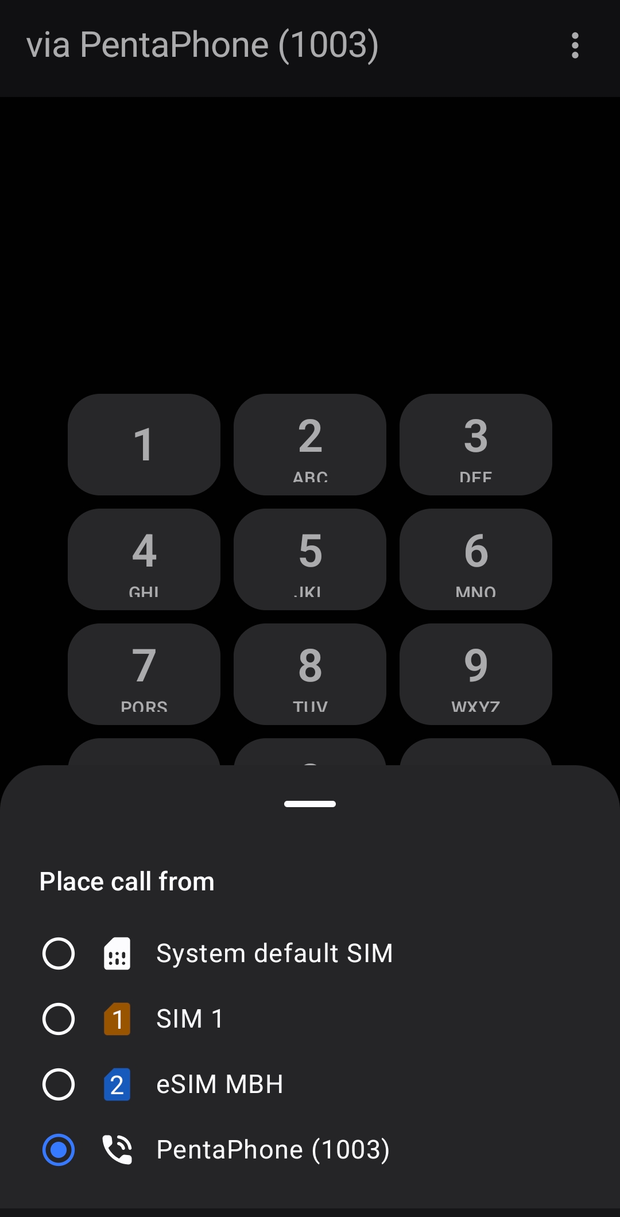
Pick the line per call — SIM 1, eSIM or the company extension, from the same keypad.
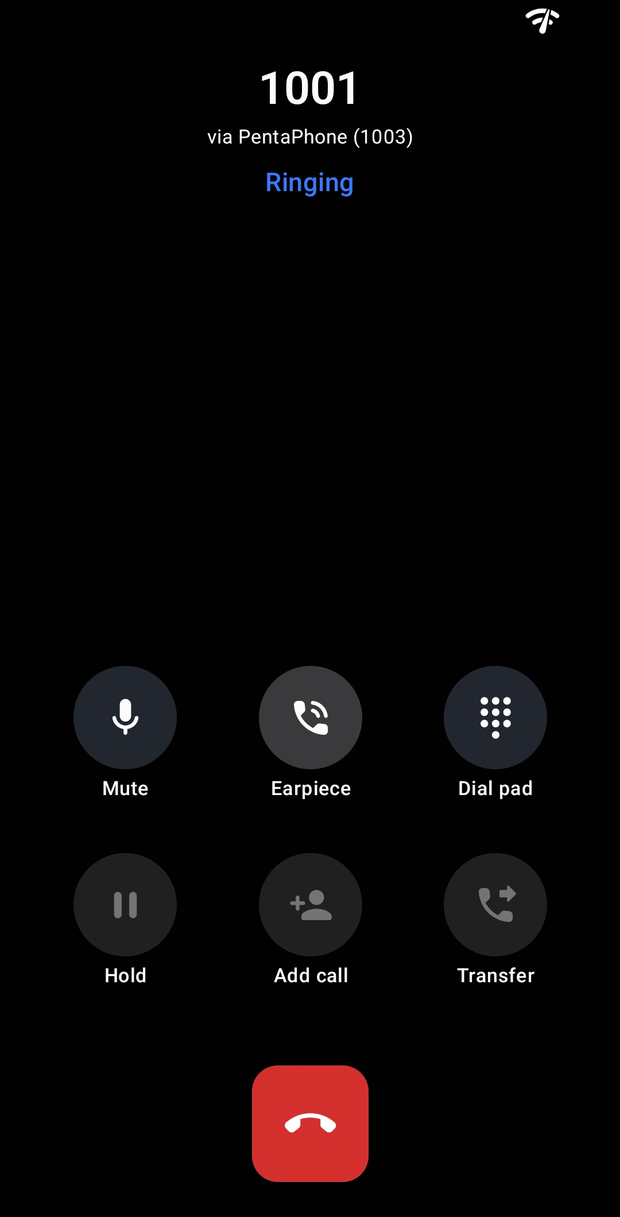
The call goes out over the company extension, in the phone's native call screen.
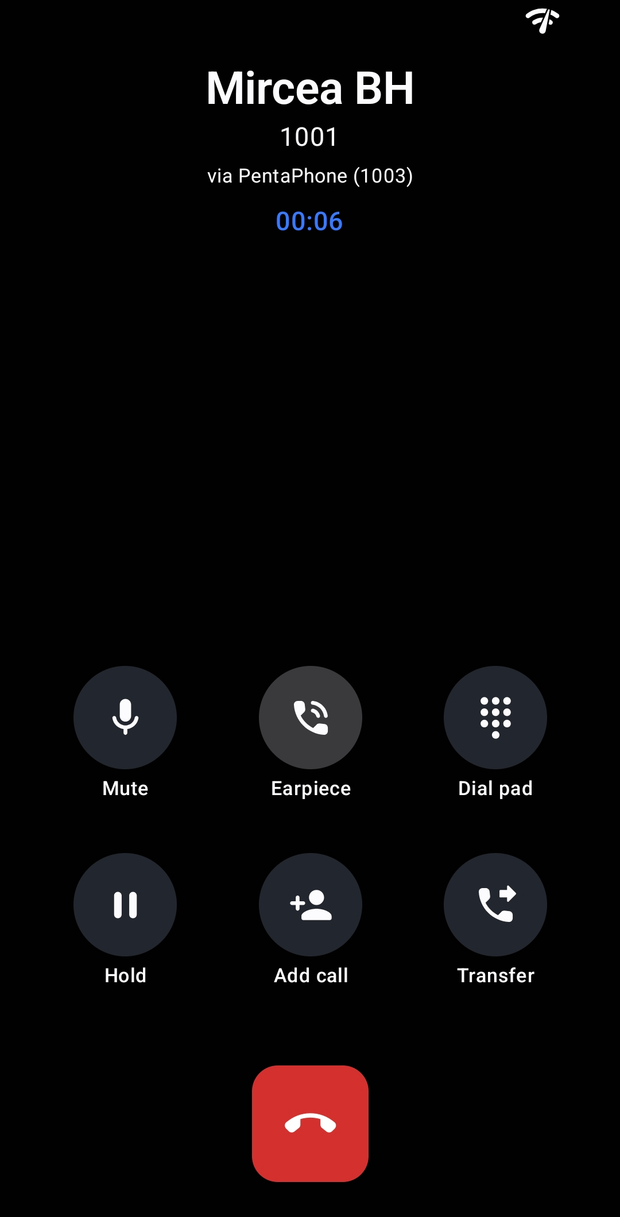
Mute, earpiece, DTMF pad, hold, add call and transfer — on every call.
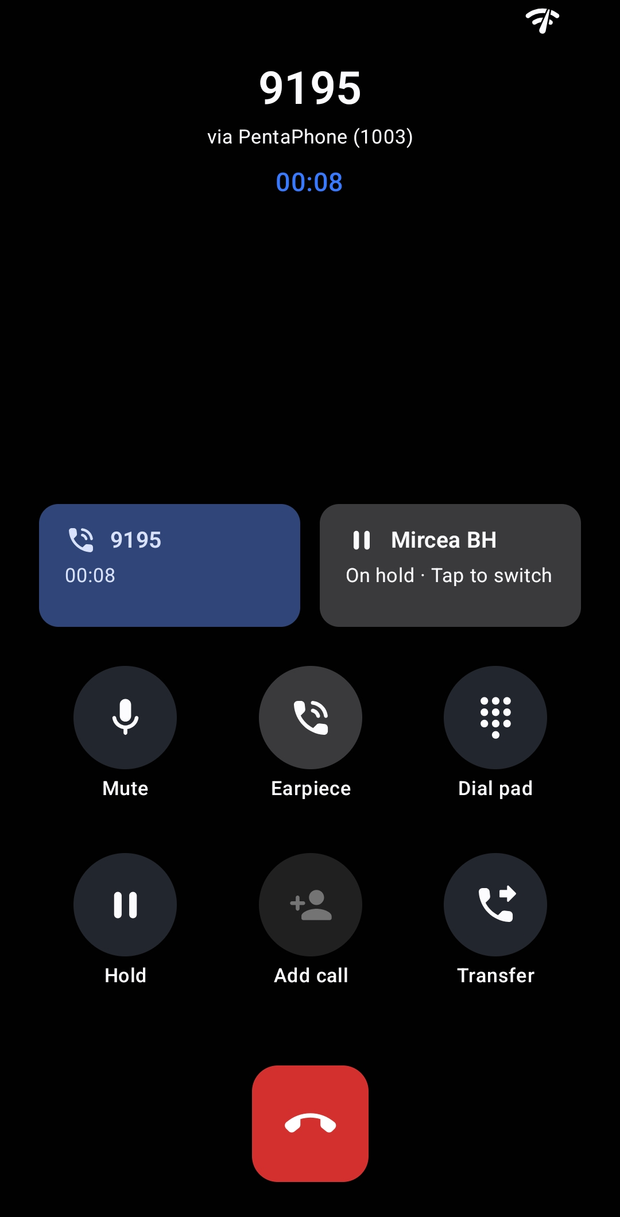
Two calls at once: one active, one on hold, swap with a tap.
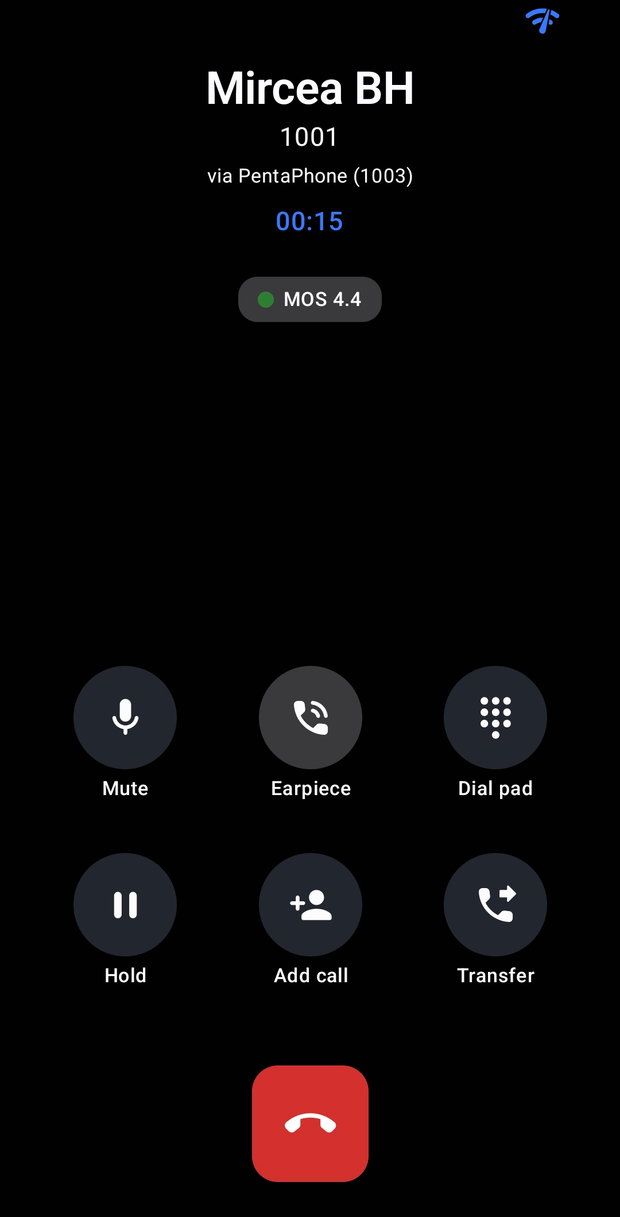
The call's MOS score, live on screen — quality is visible without a separate test.
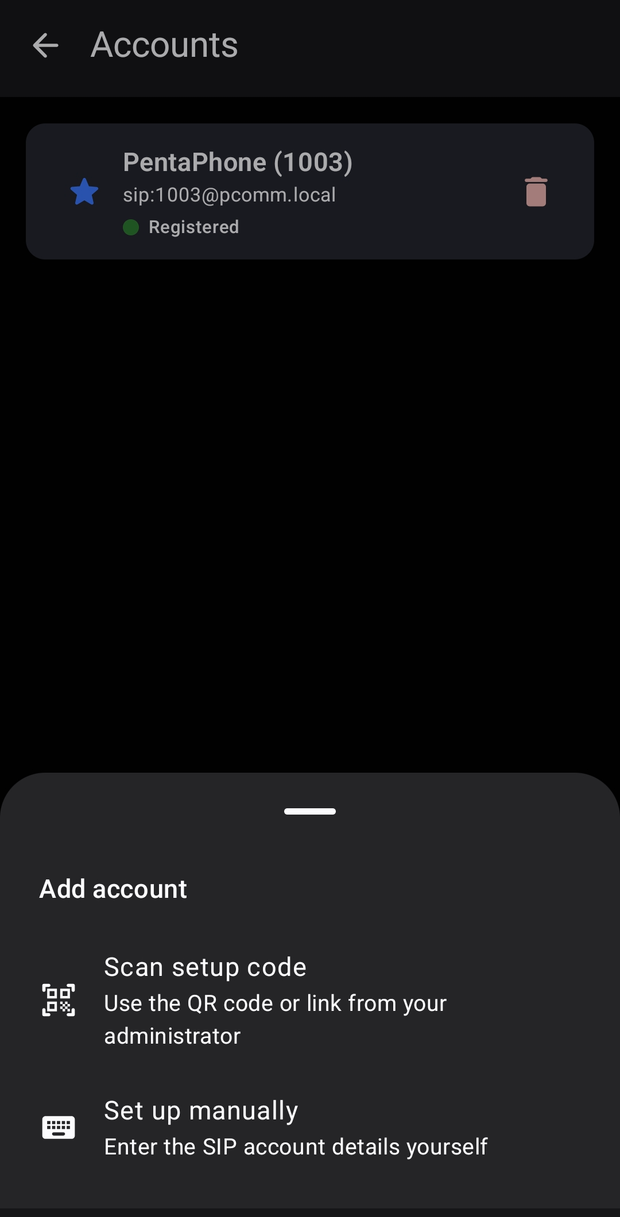
The account is added by scanning a QR code from the administrator; registration state stays visible.
The office extension travels with the employee. Calls to the company number ring the mobile over data; outbound business calls present the company identity — lower mobile charges, consistent customer-facing numbers.
Standards-based push wake-up (RFC 8599) rings the phone even when the app is closed or the device is in deep sleep, with an automatic fallback where push is unavailable. Reachability is never silently lost.
Signalling runs exclusively over TLS and voice media over DTLS-SRTP; encryption cannot be switched off. Credentials live in hardware-backed encrypted storage, and private on-premises certificate authorities are supported.
As a Telecom-framework default dialer, PentaPhone calls behave like ordinary phone calls: Bluetooth car kits, headsets, and wearables just work, and emergency numbers (112/911) always use the mobile network.
Call waiting, swap, blind and attended transfer, voicemail with message-waiting indication, and a unified company call log.
Multi-account and dual-SIM aware, QR-code provisioning, automatic registration after reboot, live call-quality metrics, and one-tap redacted diagnostics for fast IT support.
Each area below is shipped and production-ready today, in one application, with a guided first-run onboarding.
Incoming calls wake the phone through a high-priority push triggered by the SIP registrar itself (RFC 8599) — no third-party SIP push gateway sits in the call path. The phone rings from a closed app, deep sleep, or battery-optimized state, and falls back automatically to a battery-aware persistent connection on devices without push services.
Signalling is SIP over secure WebSockets (TLS) only, and media encryption (DTLS-SRTP) is compiled in as mandatory. The product cannot be misconfigured into sending calls in the clear.
Ships with the Pentacomm root CA scoped to the app (it never touches the device trust store) and supports on-premises or self-signed server certificates through an explicit administrator approval flow with review and revocation.
Deep Android Telecom integration means system-grade behaviour: lock-screen answering, Bluetooth and car-kit controls, correct audio focus, and emergency-call safety (112/911 always over the mobile network).
The SIP protocol stack is developed in-house and the WebRTC media engine is built from audited source. No third-party SIP libraries sit in the call path, and quality, security, and support remain under one roof.
Crash reports are scrubbed of personal data before leaving the device; diagnostic bundles are redacted and shared only by explicit user action. No advertising or analytics SDKs.
The signalling stack is covered by an automated protocol test suite (golden traces from real platform traffic), and every release passes CI build, test, and lint gates before it ships.
One dialer. Every call encrypted. Reachable around the clock — on the phones your team already carries.
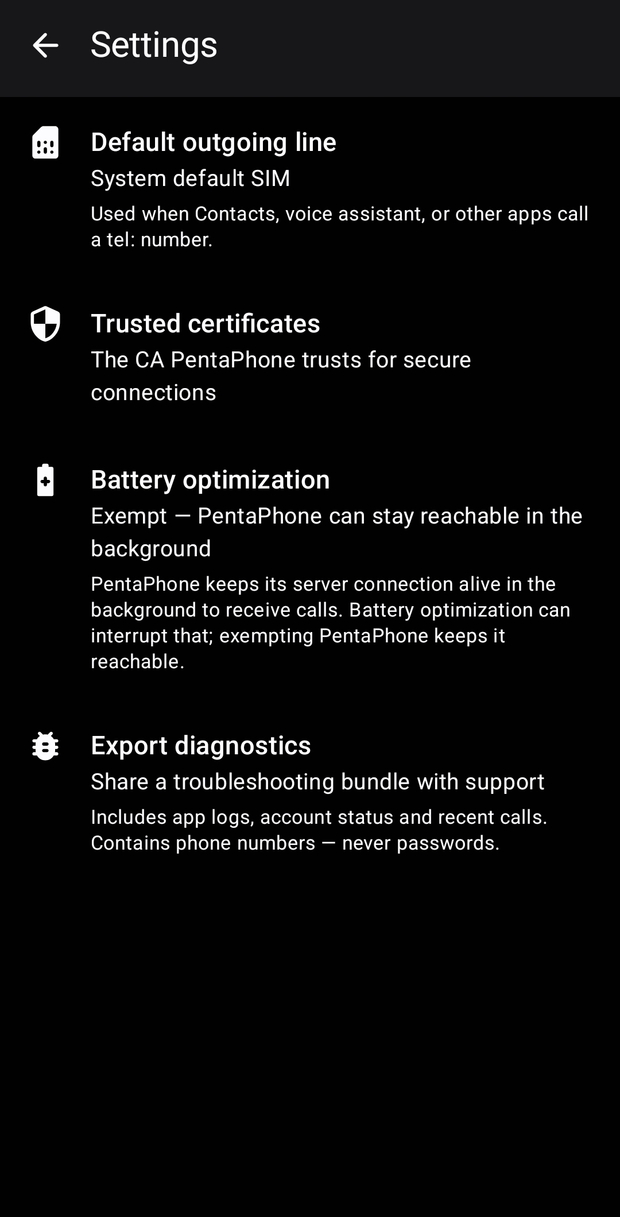
The controls an administrator needs live in the app, not buried in Android's settings.
Most softphones still speak SIP over UDP — a transport designed for desk phones on a managed office LAN, not for devices that roam across corporate Wi-Fi, guest networks, hotels, and mobile data. PentaPhone deliberately ships a single signalling transport — SIP over secure WebSocket (RFC 7118) — and the difference shows up exactly where softphones traditionally fail:
Calls connect on networks where traditional softphones fail — with no firewall tickets, no SIP-ALG battles, and no exposed ports.
The app evolves alongside the Pentacomm platform. The following capabilities are planned on the same standards-based foundation.
Three-way and multi-party audio conferencing from the in-call screen, built on the Pentacomm audio conference bridge.
1:1 video calling — the shipped media engine already carries the full WebRTC video stack, secured by the same DTLS-SRTP edge.
Per-message voicemail list with in-app playback — and transcription, paired with the platform's voicemail-transcription module.
A synchronized directory of colleagues and shared contacts served by the platform, merged into the Contacts tab with caller-name lookup.
one extension per employee that works identically at the desk, at home, and on the road, with consistent policy and one call log.
field service, sales, and operations teams that need the company number with them, without carrying a second device.
keep the PBX feature set (transfer, hold, voicemail, call waiting) while retiring per-desk hardware.
every call encrypted end to end, credentials in hardware-backed storage, and support for a fully private PKI.
See Pentacomm running on a live appliance and PentaPhone registered against it — or against your existing SIP platform. Talk to us about a proof-of-concept, licensing, and deployment.
Talk to us